Wednesday, March 9, 2011

Little Pig, Little Pig, Won't You Come Home?


One of the fat boys has gone missing. I'm afraid he was pig napped while I was at Cow College. (Now there's a sentence I never thought I'd write.)

In an attempt to know the provenance of the food my family eats, I got two pigs last summer. I didn't know anything about pigs, but my husband's family used to keep them. He said I needed a way to call them; you know "here piggy piggy" or "sooey." Channeling my inner Helen Bonham Carter, I decided to call them my fat boys. I'd walk out of the house every morning and call "Come here fat boys. Bring me my fat boys," and they would run to the fence to see what treats I had brought them. My fat boys love pancakes, and I can honestly tell you I was tempted to make some just for them rather than feeding them the boy's leftovers.

I loved my fat boys so much my husband said I would never eat them. I told him he was wrong, but I would cry while I did it. Pigs are charming animals. They are also pigs in the classic definition of the word. They climb over each other and anything else to eat, and they eat all the time. They can't be led with a can of food like the goats because they never raise their heads enough to see the can. They root in the ground for God knows what occasionally unearthing horse shoes and other oddities. They have torn up their pen with their digging and actually tunneled under the fence.

That is how the fat boys escaped. They tunneled under the fence while I was covering Cow College and went on a bender tearing up my husband's paths and stone walls looking for tasty bits. When I came home there was only one pig standing outside the pen waiting for me.

As much as I love my fat boys, they love each other more. I can't imagine one would have come home without the other if something hadn't happened. This is why I think he was pig napped.

The remaining pig lives alone now. He misses his buddy; I can tell. Before, the fat boys would retire for the evening as soon as it looked like it might get dark. Now my sole fat boy stays up past dark, I'm sure waiting for his buddy to come home.

He also has to carry all my production costs on his tasty shoulders. With only one pig left, my pork should finish at around $75 a pound. I am some kind of farmer.

Monday, February 21, 2011

One Fish, Two Fish


I love writing for Lancaster Farming. I get to tour places I wouldn't be able to visit and see how different kinds of agriculture works. Recently, I had a chance to cover a farm that doesn't look anything like a conventional farm. (LF 1/22/11 A5)

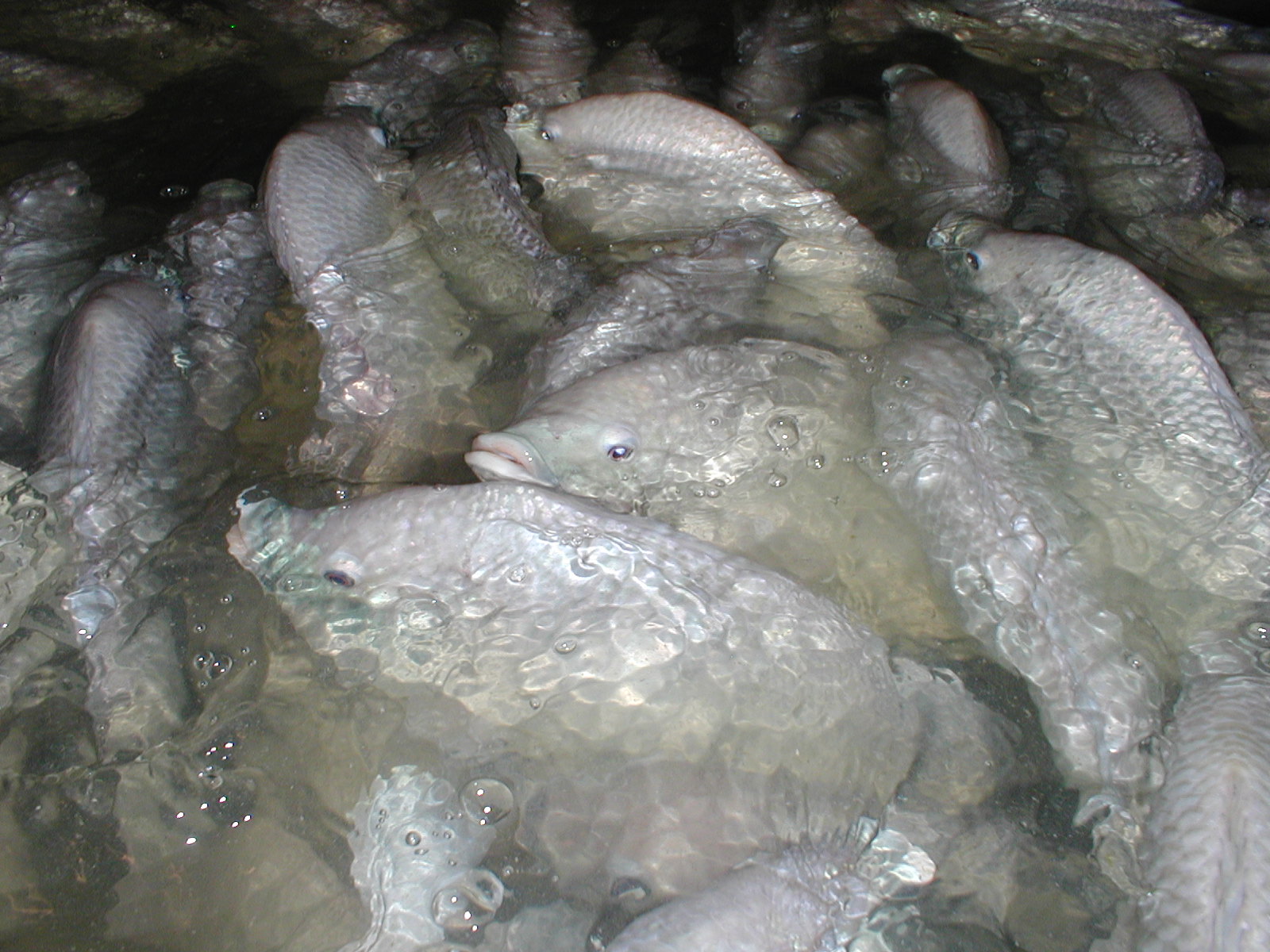
Blue Ridge Aquaculture (BRA) in Martinsville, Virginia is the world's largest indoor fish farm. The facility is in an ordinary looking industrial park, but the operation inside is anything but ordinary. In its 100,000 square foot facility on less than two and a half acres of land, BRA raises over 4,000,000 pounds of tilapia every year. In contrast, using the National Cattlemen's Beef Association statistics, less than 10,000 pounds of beef could be produced on the same acreage and not in an industrial park. It also takes about six times as much feed to produce one pound of beef as it does to produce a pound of tilapia.

BRA uses an indoor recirculating aquaculture system to grow the tilapia minimizing any environmental impact. About 85 percent of the water is returned to the system and the waste is filtered out for other uses. BRA is experimenting with raising herbs and vegetables in the nitrogen rich water, and the solids can be used to fuel methane digesters.

Fish are packed together in 35,000 gallon tanks, but unlike other large scale animal production which may require the prophylactic use of antibiotics and growth hormones to overcome stress caused by high animal densities, the tilapia actually benefit. Being packed together makes the fish less territorial and aggressive and improves health and growth rates.


We're used to thinking of seafood as a healthy, low fat protein. Over 80 percent of the seafood consumed in the United States is imported, however, making it by far the most imported food consumed in the country. Seafood is very susceptible to contaminants like mercury, antibiotics and hormones, and less than five percent of the seafood coming into the country is tested.

Dairy farmers contribute to a marketing campaign promoting dairy products. Everyone knows the "Got Milk" commercials. Domestic seafood producers could benefit from a similar program. I know I would buy domestic over imported if I had the choice. American seafood is cleaner, safer and a healthier choice.

Blue Ridge Aquaculture sells 10,000 to 20,000 pounds of live fish every day to distributors in New York, Boston, Washington D.C., and Toronto. It is a fantastic idea, enabling producers to raise healthy protein near population centers and in places where it would be almost impossible to farm any other way.

If your interested, you can find more information a http://www.blueridgeaquaculture.com/ Thanks to Jim Franklin for showing me around and Lancaster Farming for giving me the opportunity to cover this new kind of farm.

Friday, January 28, 2011

The Tenacious Miss Griscom

One of the best/worst parts of having school age children is homework. This week, my middle son had a project on Betsy Ross. Like most people, I knew Betsy Ross was credited with making the first American flag. I even remembered the story about how she convinced George Washington to use five-pointed stars instead of six. I didn't know anything about Betsy Ross, the woman.

Born January 1, 1752, Elizabeth (Betsy) Griscom was the eighth of 17 children. Betsy was apprenticed to an upholsterer and learned to make and repair rugs, umbrellas, and bed coverings. She fell in love with fellow apprentice, John Ross. Betsy was a Quaker, however, and John was not. Quakers were not permitted to marry outside their faith.

John and Betsy eloped when she was 21 years old, crossing the Delaware River to be married in New Jersey. She and John started a successful upholstery business, but less than two years into their marriage, John was killed in a munitions explosion. He left Betsy a childless widow.

She continued to run their business, and there was that bit about the flag. Betsy went on to remarry. She was only Betsy Ross for about four years. She buried three husbands and two children as well as her mother, father and sister within days of each other. She continued to work into her 70's, and by 1833, she was completely blind. She died at the age of 84.

Making the first American flag is an important achievement. More important, however, is the tenacity with which Betsy lived her life.

I've been thinking a lot about tenacity lately. I'm querying agents, not fighting a revolution, but I don't handle rejection well. I want people to like me and my writing right away, the first time. I've realized I'm not as tenacious as I thought I was. I'm working on that. Betsy Ross is a spectacular example.

Monday, October 18, 2010

There was a bear right there...


We spent most of our time in Yellowstone driving around looking at the animals that live in the park. The bison walk on the road and my sister is crazy about them so we saw lots of bison. At times they walked right beside the Suburban, their massive heads almost scraping the windows. We even saw one licking the bumper of the car in front of us. Never did figure out what you have to do to get that to happen, but it was a good threatening point with the kids. (Behave or we’ll smear you with peanut butter and tie you to the bumper!) It prompted the advent of the “peanut butter list.” (Mommy, am I on Aunt Julie’s peanut butter list?)

We also saw moose, coyote, mountain sheep, a black bear and some little spots I’m sure were wolves. Mom and Dad were locals and knew exactly where to go to see the “good animals.” At one point my brother-in-law went on point like a bird dog jumping out of the vehicle to see a mama grizzly and cubs. They were very far away – only visible through the binoculars and without his keen powers of observation we would have missed them. That was not true of the second grizzly bear.

It was our next to last day when we encountered the “bear jam,” a pile up of cars that usually meant a good animal sighting. I was sitting in the coveted shotgun seat. I’m shorter than everyone else in my family so I don’t get to sit in it often. We rolled down the window and a lady told us they had seen a grizzly bear, but it had walked off into the woods. By this point we were animal connoisseurs and didn’t stop for just anything. Besides the ranger was walking away from the bear jam and he wouldn’t be leaving if the bear was still there. The rangers are great at showing up when the bears do and protecting tourists from themselves.

We kept driving slowly; traffic wasn’t moving much. Eventually we pulled up beside the ranger and the bear was RIGHT THERE mere feet away. A huge grizzly bear was outside my window – my window. A man was eaten by a mother grizzly and her cubs a few weeks before we arrived in Yellowstone and my sister had read us excerpts of Death in Yellowstone. Grizzly bears are fast and unpredictable with really big teeth and claws. My mom handed me her camera to take pictures. I didn’t. I rolled up my window and tried to stay off of the peanut butter list. My family teased me mercilessly for being scared. I prefer to think of it as prudent, but I don’t think they will ever let me ride shotgun again.

Saturday, October 9, 2010

This is Yellowstone


My three sons and I along with my sister and her husband- God bless them, packed ourselves into the rented Suburban, left the Great Salt Lake and headed to Pocatello, Idaho. I was operating on two hours sleep and the residual adrenaline of getting myself, three carryon bags, three backpacks, a laptop bag, car seat and three small boys through airport security (Get your shoes back on now!) I admit I was not paying as much attention to the passing scenery as it deserved, but we were definitely not on the east coast any more. The beautiful countryside was dotted with fields made green by rolling irrigation systems all set against the backdrop of spectacular mountains.

We spent the night in Pocatello and woke up closer to human the next morning. After my sister pried my middle son away from his waffle we were off to meet Mom and Dad in Ashton, Idaho, the self proclaimed seed potato capitol of the world. The irrigated fields along the highway were covered with gorgeous green Hesston bales. Much larger than the square bales I’m used to, these bales were like Legos on steroids and were stacked uncovered in the fields. My sister asked the boys why the farmers could leave the bales uncovered (She’s worse than I am for never missing a chance to educate.) My oldest - never one to let a question pass without giving an answer – said it was because it didn’t rain much.

He’s right. Average rainfall in southern Idaho ranges from around 10 inches a year to just over 20 inches. Rainfall increases the closer you get to Yellowstone (a volcano-created valley funnels moisture to the park), but it is still less than half of what we normally get in southwest Virginia. The fields filled with nutritious hay and delicious potatoes would not grow without irrigation, and the animals and people they feed would be forced to look somewhere else.

One of my favorite freelance jobs was writing for Lakelubbers.com. In addition to the nice people I worked with, the part I liked best was researching the history of lakes across the country. So many of them started as reservoirs to irrigate crops and often the idea to divert water from area rivers went back to the time of the Spanish missionaries – people who saw the potential in the land if only there was just a little water. Irrigation has changed our rivers and our agriculture.

Some of the changes are obvious. When the Rio Grande runs dry before it hits Mexico, conservationists and Mexican farmers are right to question what we are doing with all the water. Those of us on the East Coast eating potatoes covered with butter made from milk given by cows fed on those beautiful hay bales need to be aware before we condemn. We are more connected than we realize.

My middle son wanted to be connected to his breakfast, but my sister was on a schedule. Turns out she was right to be concerned; Mom and Dad were early. When we pulled into Ashton my kids flew into their arms. It is one of my life’s true blessings to see how they love each other. We all missed them so much and having a week stretching in front of us to explore our Nation’s first national park was a bonus. Spending time together was the real treat.

I’m so proud of my mom and dad. Ignoring all the reasons why they shouldn’t, they left in July to go work in Yellowstone. It was one of the items on their bucket lists. They are having a real adventure together, but my sister and I can’t wait for them to come home.

Tuesday, September 21, 2010

The Great Salt Lake


On July 24, 1847, Brigham Young and his flagging congregation of the Church of Jesus Christ of Latter-Day Saints reached what he declared to be the Promised Land. They found this.

The Great Salt Lake is glorious, striking, beautiful and fascinating, but welcoming it is not. I cannot imagine making the difficult journey from Illinois, watching loved ones sicken and die only to be told that this is where we were going to live.

Leftover from the pre-historic Lake Bonneville which stretched across more than 22,000 square miles during the last Ice Age, the Great Salt Lake is 75 miles long by 28 miles wide. It covers 1,700 square miles and has a maximum depth of 33 feet. The lake has no outlet; water only leaves by evaporation and with over 2.2 million tons of minerals flowing into the lake each year it is anything but fresh. Depending on evaporation the lake’s salinity is between four and 28 percent. As a frame of reference, the ocean is at three percent. Although it does support brine shrimp and birds, the water is too salty for fish. Algae thrive in the lake and it literally smells like brimstone.

We arrived at the Great Salt Lake the week after I covered the Heritage Harvest Festival for Lancaster Farming. The Festival, held on the grounds of Monticello, was a celebration of small local producers: artisan farmers and craftspeople who grew heirloom fruits and vegetable and made goat’s milk cheese and cider. It was lovely and the homemade donuts were the best I’ve ever eaten.

Standing on the shore of the Great Salt Lake, however, Buy Fresh Buy Local took on a whole new meaning. It is one thing to try to shorten food chains in central Virginia or in Lancaster County, Pennsylvania where I grew up. But there are whole sections of the country where food for people does not easily grow. If we move to a local food system, who is going to feed those people?

Eventually, the Mormons thrived. I’m not sure that the same would be true for their contemporary counterparts. Given the number of people now living in the Salt Lake Valley, they better like brine shrimp.

The Great Salt Lake is extraordinary. I’d been there before, but every time I travel I am reminded of how magnificent our country and world is. Next stop – Yellowstone!

Saturday, September 4, 2010

Button Jars


Faced with a long summer in a house full of boys, I started “button jars” for chores. I filled three blue mason jars with buttons left over from when my Grandma Lucas worked in the garment factory. Each boy got a pair of jars – one with buttons and a tag with their initial and one empty one with a tag where they wrote what they wanted to earn. The three year old wanted Buzz Lightyear Legos. The eight year old waffled between an incubator to clone dinosaurs and a remote control helicopter. My ten year old knew immediately he wanted a new bike.

All summer long the boys did chores to earn buttons and we watched one jar fill as the other jar emptied. The rallying cry around our house became “Mom, how many buttons is this worth?” The answers ranged from two buttons to “Just do it because I told you to!” There were hundreds of buttons in the jars and as the summer progressed the initial enthusiasm began to fade for everyone except the ten year old. He wanted that bike.

He helped around the house, fed and cared for the animals and worked alongside his daddy in the dirt and heat. He came in sweaty, filthy and sometimes exhausted. Every night after his shower he held out his hands to catch the buttons he’d earned that day.

Ever since he was a little boy, his daddy and I have had to remind each other that he is a kid. He has always been so grown up; when he does something childish, it catches me off guard. This summer with the button jars made it even harder to remember he’s a child. He worked like a man -albeit a young one -next to his daddy for long days in 100 degree heat. He did not complain. He was enthusiastic and a joy to have around, and he earned his buttons.

On Wednesday he dropped the last two buttons into his jar, and on Friday his bike was waiting for him when he got home from school. I am so proud of him and so impressed with his determination. Much more important, however, he is proud of himself, and he’s learned how good it feels to have something you worked hard to get.